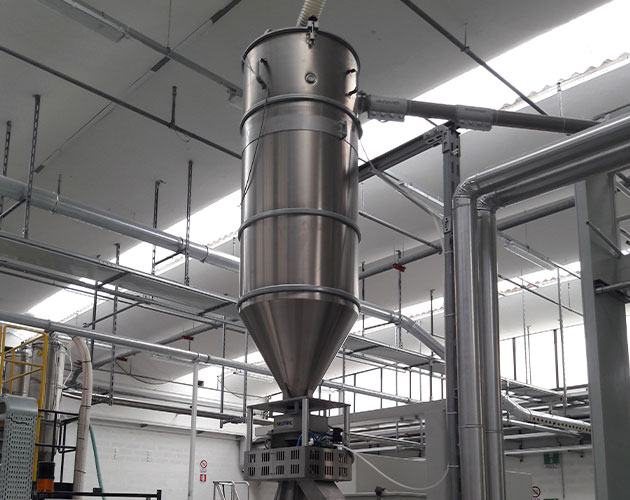
For conveying materials that tend to agglomerate.
In the alternating dense-phase pneumatic conveying mode, air is injected alternately with material, advancing the latter in segments separated by air.
Seeds, plastic granules, or pellets are materials of roughly the same size and tend to occupy the entire cross-section of the conveying tube. Therefore, most of the air mass drags the blockage, while the air passing through the interstices of the materials creates a constant flow of advancement.
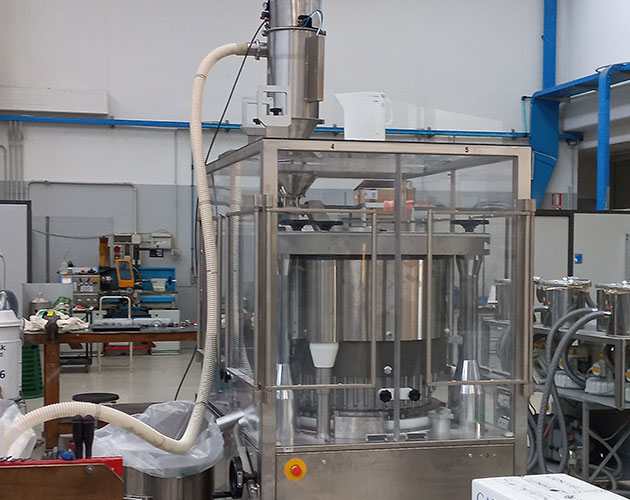
To transport fine powders with a high specific weight.
In the continuous dense-phase pneumatic conveying mode, a small amount of material is fed into the pipe at a time, so that the material does not fill the entire pipe section, but rather advances by flowing along the lower part of the pipe itself.
Visually, a series of waves can be seen steadily advancing toward their destination.
For conveying powders that tend to coagulate.
The intermittent dense-phase pneumatic conveying mode prevents the material from coagulating, which would cause blockage of the pipeline. A second, smaller-diameter pipe is inserted into the main pipeline, which injects air into the main pipeline at programmed intervals to maintain high material flow. This prevents compaction of the material and consequent blockage of the pipeline.